Best Contract Workflow Automation Tools: 2026 Comparison
Compare the top contract workflow automation platforms for operations and procurement leaders in 2026. Discover how platforms like Zelosify, Ironclad, and Sirion streamline approvals and stop spend leakage.
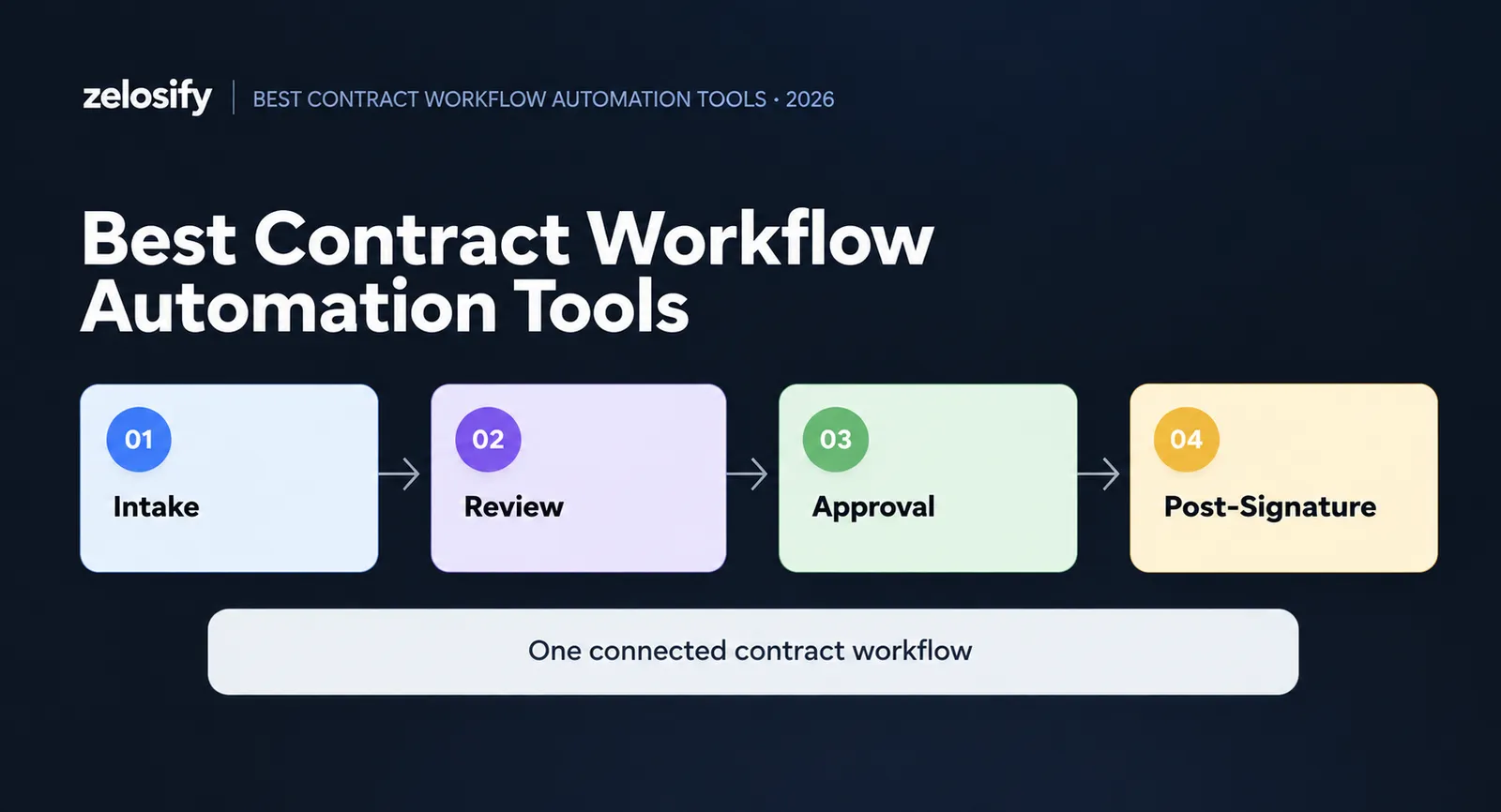
When the review of contracts is manual, operations and procurement leaders face bottlenecks daily. Without workflow automation, approvals sit in individual inboxes, version control becomes a nightmare, and signed agreements go unmonitored. This guide compares the top contract workflow platforms such as Zelosify, an AI VendorOps platform that unifies vendor contracts, timesheets and invoices into one operating workflow, and outlines the key criteria to consider when choosing the platform that best suits your workflow.
Key Takeaways
- Contract workflow automation processes are placed on top of the document layer and manage the sequence of the contract through legal, finance, and procurement processes based on predefined business rules.
- Narrowing down the specific tool you're considering will match your company's area of focus, pre-signature legal redlining versus post-signature invoice verification.
Why Look for Workflow Orchestration?
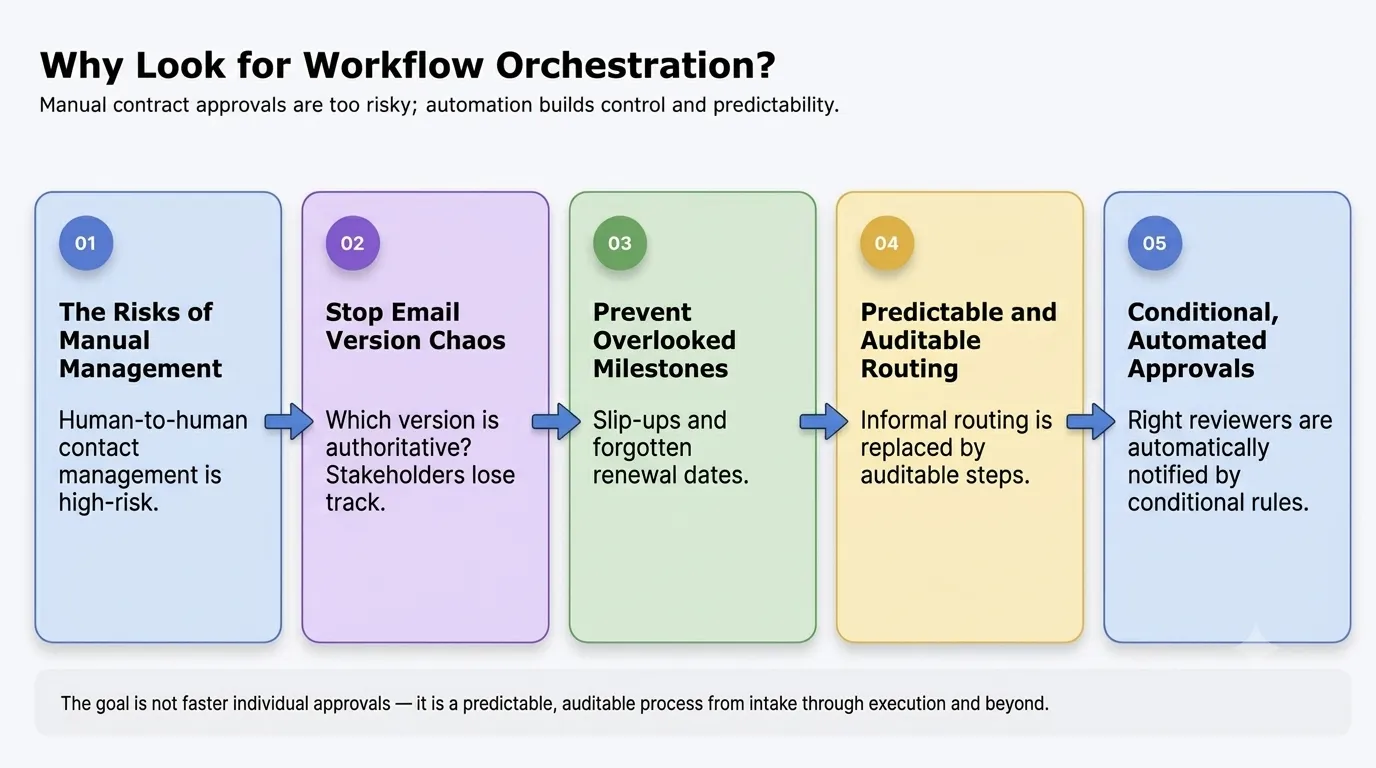
The human-to-human management of contract approvals creates a great risk for any expanding company. Email attachments to contracts creates a situation where stakeholders can no longer keep track of which version of a contract is the authoritative version, or notice periods or renewal dates can slip away without notice. That informal routing is replaced with a real workflow automation system. Predictable and auditable by design, conditional rules automatically route to the right reviewers — such as legal counsel for liability changes or finance heads for value escalations.
Standardized Comparison Table
This table lists the leading contract workflow applications according to integration and/or operational focus.
| Platform | Pricing Model | Integration Depth | Key Strengths | Best-Fit Use Case |
|---|---|---|---|---|
| Zelosify | Custom pricing (sales) | Standard SaaS with custom integrations | End-to-end vendor management, from onboarding to payment validation | Teams looking to automate their vendor operations |
| Sirion | Custom pricing (sales) | API connectors / custom ERP integrations | Post-signature obligation analysis / SLA scorecard tracking | Auditing complex SLAs on enterprise service agreements |
| Ironclad | Custom pricing (contact sales) | Deep CRM and signature API integrations | Intake form designer, pre-signature redlining, workflow builder | Standardize pre-signature drafting and signing loops |
| Icertis | Custom pricing (sales) | Enterprise ERP integrations across the globe | Rule-based legal compliance and clause-library governance | Centralizing contract compliance rules across international subsidiaries |
| Coupa | Custom pricing (sales contact) | ERP integration for purchasing and spend | Purchase requisition workflows, spend approval controls | Aligning contract approvals with corporate procurement policy |
| DocuSign CLM | Custom pricing (contact sales) | DocuSign suite API connectors | Signature integrations, document template population | Lightweight pre-signature approval and signature routing |
| Agiloft | Custom pricing (sales contact) | Custom database/API configurations | Deep workflow logic configurability, custom database schemas | Building custom approval logic for unique agreements |
| Conga Contracts | Custom pricing (sales contact) | Salesforce CRM CPQ integrations | Revenue operations integration, sales workflow automation | Automating sales approval workflows and billing alignments |
Top Contract Workflow Automation Tools Reviewed
Each of the tools is oriented at a specific aspect of the operation, so you'll need to choose which one to use when you're looking for legal compliance or financial control.
1. Zelosify (AI VendorOps Platform)
Zelosify is an AI VendorOps platform that brings contracts, obligation, payment tracking and invoices into one workflow. It helps operations, finance, and procurement teams manage vendors, track contracts and deliverables, monitor billing, manage renewals, and catch billing mismatches.
- Key Pros: Manages the complete vendor lifecycle from vendor onboarding and compliance to contract generation, contract management, e-signatures, obligation tracking, and invoice reconciliation all in a single platform.
- Key Cons: Built for speed and end to end vendor management, not suited for organization requiring specialized tools.
- When Zelosify is the better choice: Zelosify is the ideal choice for organizations looking for a fast-to-deploy software that helps you manage your vendor from onboarding to finally doing the invoice reconciliation and everything in between.
- Pricing: Custom pricing (contact sales)
2. Sirion
Sirion has been designed for organisations with many service contracts and where compliance is a continuous requirement.
- Key Pros: Advanced post-signed obligation extraction and real-time SLA scorecard monitoring for teams to ensure service delivery.
- Key Cons: Configuration-heavy — specialized deployment services and actual training time required.
- When Sirion is the better choice: Large organisations with complex, service level agreements with large global suppliers.
- Pricing: Custom pricing (contact sales).
3. Ironclad
Ironclad combines legal collaboration with fast pre-signature workflows.
- Key Pros: A truly intuitive intake form designer and a collaborative redlining workspace for editing agreements together in real time, no matter if a legal team or a business team.
- Key Cons: No native post-signature billing validation, contractor management, timesheet tracking.
- When Ironclad is the better option: Organizations where the actual problem is pre-signature drafting, legal template management and signature approvals within legal.
- Pricing: Custom pricing (Contact sales).
4. Icertis
Icertis is an enterprise contract lifecycle management platform designed to help companies around the world adhere to legal requirements.
- Key Pros: Legal clauses and deep compliance rule engines ensuring consistency across various international entities.
- Key Cons: Setup is complex, implementation overhead is high.
- Where Icertis is the right solution: Enterprises that operate globally where legal governance is central and complex clause relationships need to be mapped.
- Pricing: Custom pricing (contact sales).
5. Coupa
Coupa is an enterprise business spend management platform that incorporates contract tracking within the greater procurement process.
- Key Pros: Strong integration with corporate requisitioning and sourcing systems.
- Key Cons: Heavy to roll out if all you need is contract workflows, because it assumes a full procurement implementation.
- When Coupa makes more sense: For procurement-led organizations, where the need for contract milestones that dovetail with purchase cards and purchase orders.
- Pricing: Custom pricing (contact sales).
6. DocuSign CLM
DocuSign CLM is dedicated to integration between pre-signature document generation and e-signature execution.
- Key Pros: Signature integrations and document template population.
- Key Cons: Limited support for storing documents in a library and limited printing capabilities.
- When DocuSign CLM is the preferred option: When an organization is looking to automate legal drafting and signing workflows especially.
- Pricing: Custom pricing (contact sales).
7. Agiloft
Agiloft is a very flexible contract lifecycle management (CLM) platform with a flexible database architecture.
- Key Pros: High level of customization, enabling enterprises to modify the platform to fit their complicated approval procedures and also old data sources.
- Key Cons: Needs professional services for set up and can be complicated for some users of the business.
- Where Agiloft is preferable: When the business flow of the contract is truly non-standard and doesn't align with a standard SaaS contract.
- Pricing: Custom pricing (contact sales).
8. Conga Contracts
Conga Contracts is designed from the ground up for sales-led businesses where contract processes must follow the same path as revenue operations and CPQ solutions.
- Key Pros: Deep, native Salesforce CRM integration and CPQ tools, automatic routing based on real-time deal margins and line-item pricing.
- Key Cons: Do not have an easy fit for buy-side procurement or vendor compliance work; sales pipeline-focused.
- When Conga Contracts is the right solution: Sales operations leaders who want to accelerate revenue approvals and ensure that CPQ data is accurate and clean when it arrives in executed customer agreements.
- Pricing: Custom pricing (contact sales).
When Is a Legal-First Tool Better?
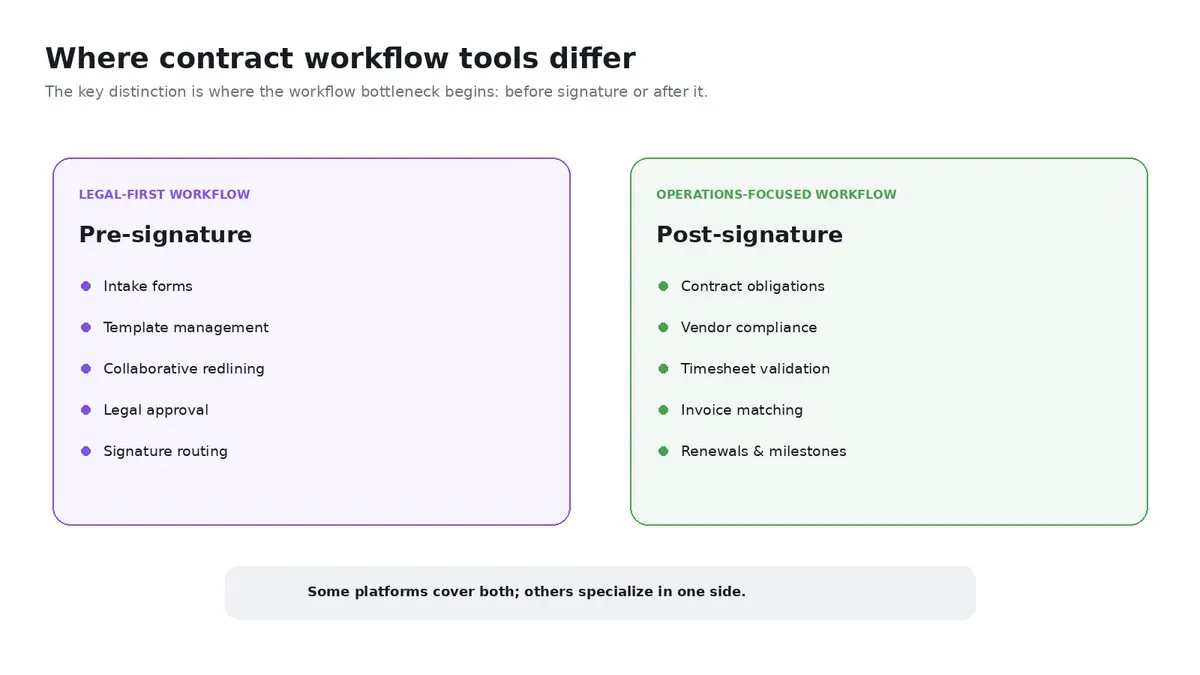
If your organization's true problem is speed of pre-signature drafting, collaborative legal negotiation, or template standardization within legal, it's time for a legal-first tool: Ironclad, DocuSign CLM. These platforms are built for drafting and negotiation, not for post-signature tracking.
Choose an operations-focused platform when your problems start after signature: vendor compliance, contractor hours, and checking invoices against the signed rate card.
Where Enterprise Workflow-Oriented Platforms Stand Apart
Automating approvals alone doesn't scale. As contract volume grows, automating individual steps without connecting the whole process only adds fragmentation: each step gets faster, but the process stays disjointed. It's here that platforms geared towards enterprise get ahead.
In workflow-first systems, a contract is not a snapshot of a process, but an operating process. All orchestration layers are connected and compliance policy gets enforced consistently and flexes to business context.
Pricing and Implementation Reality Check
Contract workflow tool pricing ranges widely depending on the value they can provide - which is driven by operational footprint. Typically, enterprise platforms charge based on a mix of user seats, contract size and active functional modules.
User Seats and License Costs
The number of users who can use a seat, plus the amount of license fees. There are flat rates for SMB tools, whereas enterprise platforms cost more the more departments you add. Include seats for law, finances, and procurement, and the price of subscriptions rises to boot!
Implementation and Setup Timelines
The deployment timelines are based on integration requirements. Simple tools take weeks to deploy. It will take months of planning and custom configuration for anything that integrates with an ERP such as SAP or a CRM such as Salesforce.
Hidden Operational Costs
Change management is underestimated all the time, as is user training. workflows that do not align with real-world processes force workers to return to spreadsheets, and that's where the software's return on investment (ROI) quietly ebbs.
New Trends Shaping Contract Workflow Automation (2026)
Contract workflow automation is shifting beyond just executing rules to providing proactive decision support. There are a few trends to be aware of:
- AI-Driven Approval Routing: AI can predict likely outcomes, suggest the right routing path, and flag unusual clauses before they reach legal.
- Unified Cross-Functional Intake Hubs: Contracts go in the pipeline via a unified form, with a standardized form of demand and with metadata captured at the initial point of intake, to prevent anything downstream from being stalled by missing elements.
- Active Post-Signature Workflows: Companies are investing in workflows that will continue to monitor obligations and renewal notices after you've signed a contract — contracts, not files.
Frequently Asked Questions
What are the top contract automation tools?
Top platforms include Zelosify, Ironclad, and Sirion. They automate drafting, approvals, and post-signature obligation tracking to eliminate review bottlenecks and stop spend leakage.
What is the difference between CLM and contract workflow automation?
Traditional CLM software focuses on pre-signature legal redlining and repository storage. Contract workflow automation orchestrates cross-functional handoffs across legal, finance, and procurement to enforce operational compliance.
What is the best AI tool for contract workflows?
The best AI tool is Zelosify, the AI VendorOps platform that turns vendor contracts, SOWs, timesheets, and invoices into one operating workflow. It automatically compares incoming invoices and deliverables against contracted terms to prevent billing errors.
How do contract workflow tools prevent billing errors?
They extract contracted rate cards and milestone deliverables from signed agreements and match them against incoming invoices. Any rate mismatch or unapproved expense is automatically flagged before payment approval.
Related Articles
Continue reading more insights and guides from Zelosify.
Top Vendor Management Software Tools: 2026 Reviews
Find the best vendor management software in 2026. Compare Zelosify, Gatekeeper, and enterprise VMS tools to streamline onboarding, contract tracking, and billing validation.
Best Vendor and Contract Management Software: 2026 Guide
A buyer's guide to the top unified vendor and contract management platforms for enterprise and mid-market teams in 2026.