Best Vendor and Contract Management Software: 2026 Guide
A buyer's guide to the top unified vendor and contract management platforms for enterprise and mid-market teams in 2026.
Vendor spend hides in places nobody's watching. A contract in one inbox, a renewal date no one flagged. That's how companies lose money without ever seeing where it went.
Vendor management software for operations teams closes that gap by bringing vendor operations into one workflow rather than being scattered across multiple processes.
Zelosify, the AI VendorOps platform that turns vendor contracts, SOWs, timesheets, and invoices into one operating workflow, does exactly this — and this guide shows you what to look for before you decide
In short
- Vendor management software for operations teams centralizes vendor operations to reduce silent spend leakage and operational bottlenecks.
- According to World Commerce & Contracting research, poor contract and vendor management costs companies an average of 9% of annual revenue.
- This guide helps COOs and Ops Heads evaluate vendor management platforms and improve visibility by identifying operational gaps.
The Best Vendor Management Software for Operations Teams (2026)
To help you choose the right platform, we evaluated the leading tools based on operational criteria.
Our comparison framework follows the same guidelines detailed in our review of Top Vendor Management Software Tools and Best Vendor & Contract Management Software. Our selection criteria prioritized post-signature execution, ease of cross-department collaboration, invoice and timesheet reconciliation, and deployment speed.
Comparison at a Glance
| Platform | Core Focus | Key Strengths | Best For |
|---|---|---|---|
| Zelosify | AI-driven VendorOps | Timesheet & invoice matching, auto-renewals, AI extraction | Mid-market ops graduating from spreadsheets |
| Gatekeeper | Vendor & renewal governance | Strong vendor portal, renewal dashboard | Procurement-led vendor compliance |
| Sirion | Post-signature compliance | Deep obligation tracking, analytics | Enterprises with complex service agreements |
| Ironclad | Pre-signature workflows | Drag-and-drop workflow designer, redlining | Teams focused on contract drafting velocity |
| DocuSign CLM | Agreement lifecycle | DocuSign eSign integration, repository | Existing DocuSign customers |
In-Depth Reviews
1. Zelosify (AI VendorOps Platform)
Zelosify is an AI VendorOps platform that turns vendor contracts, SOWs, timesheets, and invoices into one operating workflow. It is built specifically to address the graduation moment when mid-market operations teams outgrow spreadsheets and need to stop spend leakage.
- Key Strengths:
- It automatically extracts contract metadata and reconciles incoming invoices against contractor timesheets and SOW milestones.
- Zelosify features native onboarding checklists and manages user access by provisioning roles (ADMIN, VENDOR_MANAGER, VENDOR) securely.
- Runs a localized RAG pipeline to answer user questions about active contract obligations.
- Limitations: Optimized specifically for regional and mid-market organizations.
- When Zelosify is the better choice: Zelosify is the ideal choice for operations and finance leaders who want to eliminate manual work, prevent overbilling, and centralize vendor management without the bloat of traditional enterprise tools.
2. Gatekeeper
Gatekeeper is a cloud-based vendor and contract management solution designed to manage supplier risk and improve compliance.
- Key Strengths: Features an excellent vendor portal that permits suppliers to self-onboard and upload compliance documentation directly. Its visual Kanban workflow engine makes it easy to track the progress of vendor approvals.
- Limitations: Built primarily for vendor risk and contract governance rather than deep financial/reporting workflows — users report limited dashboard/report customization and want more comprehensive analytics depth.
- When Gatekeeper is the better choice: It is best when your primary bottleneck is vendor risk compliance and supplier document collection.
3. Sirion
Sirion focuses on post-signature contract value, tracking performance against complex service level agreements (SLAs).
- Key Strengths: Provides advanced AI-powered obligation extraction and detailed supplier scorecard analytics.
- Limitations: Enterprise-grade depth comes with a steeper learning curve and longer implementation timeline.
- When Sirion is the better choice: Sirion is suitable for large enterprises managing highly complex, multi-million dollar service contracts with deep performance dependencies.
4. Ironclad
Ironclad is a digital contracting platform that accelerates how contracts are created, negotiated, and signed.
- Key Strengths: Exceptional pre-signature workflow builder, collaborative redlining, and an intuitive drag-and-drop editor.
- Limitations: As a pre-signature-first platform, post-signature document search can be less robust.
- When Ironclad is the better choice: Ironclad is best for organizations where the legal and sales teams need to draft and execute high volumes of standard agreements rapidly.
5. DocuSign CLM
DocuSign CLM organizes files, automates workflow steps, and facilitates collaboration during negotiations.
- Key Strengths: Seamless, out-of-the-box integration with DocuSign’s industry-standard electronic signature system.
- Limitations: Requires significant professional services and a lengthy rollout (often 3–6 months) to configure advanced workflows — the administrative interface has a steep learning curve for new users.
- When DocuSign CLM is the better choice: Best for enterprises already heavily committed to the DocuSign ecosystem looking to centralize their contract storage.
What Is Vendor Management Software for Operations Teams?
VMS is used by the operations team to act as a centralized execution layer that connects vendor-related operations like vendor contracts, SOWs, timesheets, invoices into a single workflow. Unlike procurement-only systems, which manage the purchasing lifecycle, it focuses on day-to-day operational control. Post-signature operational visibility, ongoing performance tracking, and clear accountability are also built in to prevent contract leakage and communication bottlenecks.
Examples includes a VMS automatically rejecting or flagging a contractor’s timesheet when it exceeds the pre-negotiated SOW budget limit, or triggering automated alerts before a vendor’s compliance certification expires
While procurement teams buy the software, operations teams must live with the consequences of vendor delivery. When systems remain siloed, operations leaders inherit a web of operational blind spots like untracked agreements, missing milestones, and hidden renewals.
How Should Operations Teams Evaluate Vendor Management Software?
Operations teams should evaluate vendor management software based on how easily business users can adopt it and how well it fits existing workflows and systems. Operations leaders should prioritize platforms that business users can navigate without extensive training.
1. Ease of Adoption Across Non-Legal Teams
If the software requires extensive technical training or feels too rigid, adoption can suffer. Choose a tool that lets managers check vendor status and handle routine tasks such as timesheet approval and renewal reviews without a struggle.
2. Time-to-Value and Deployment Effort
Avoid platforms that require months of configuration before teams can start using them. Operations needs a system that improves visibility into upcoming renewals. It should import existing contracts and surface key dates and renewal deadlines within weeks.
3. Workflow Automation and Controls
The tool must support custom approval gates and automated notifications for tasks that require action. For example, If a contract is approaching its notice window, the software should automatically nudge the assigned owner.
Vendor Management vs. Other Business Systems
To choose the correct tool, operations teams must understand how dedicated vendor management platforms differ from adjacent corporate software categories.
Vendor Management vs. Vendor Lifecycle Management
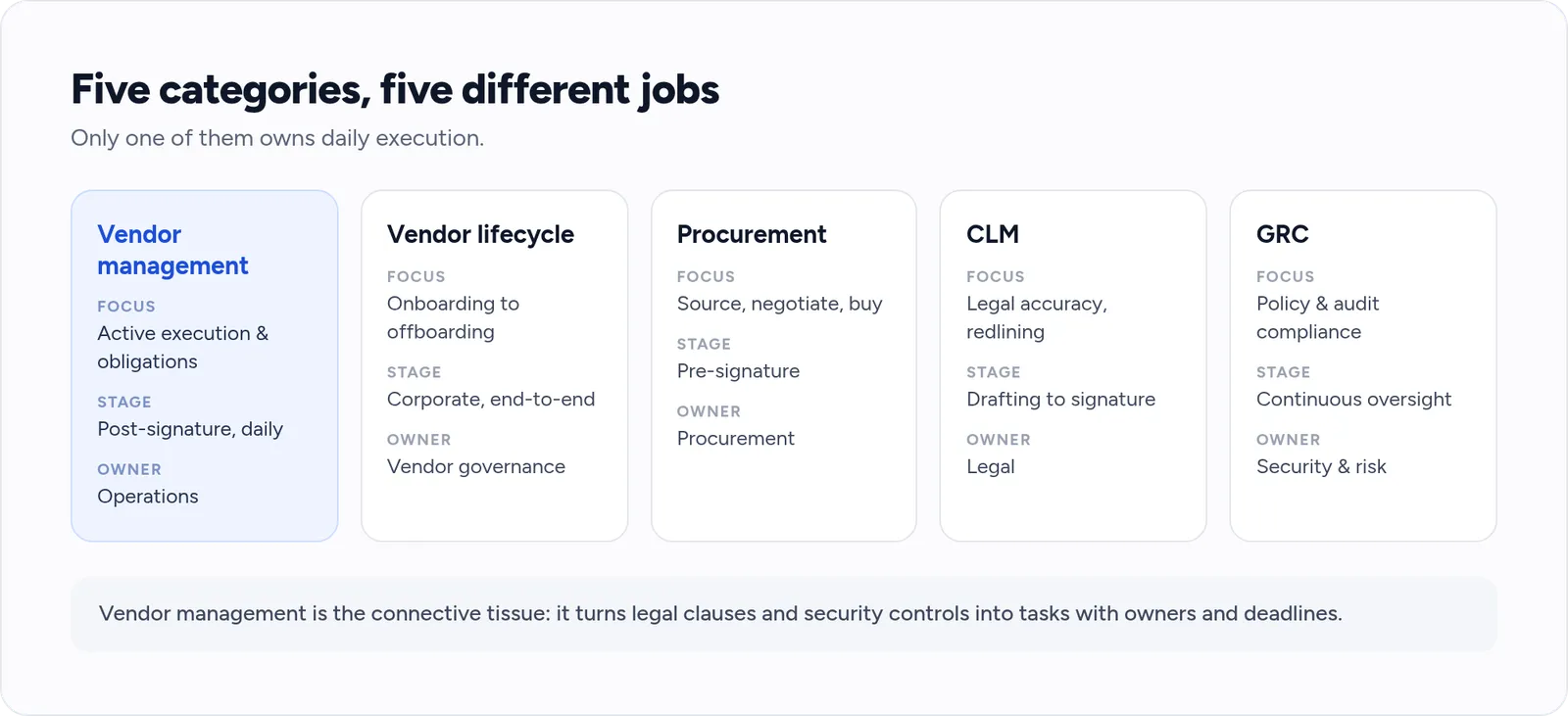
Vendor lifecycle management extends across onboarding, renewals, amendments, and offboarding at a high corporate level. Day-to-day vendor management focuses on the active execution layer. It answers operational questions like who owns the vendor, what commitments exist, and whether obligations are being met during active service delivery.
Vendor Management vs. Procurement Tools
Procurement tools are built to source, negotiate, and purchase. They optimize spend, approvals, and initial buying workflows. Once a vendor is onboarded, their operational visibility fades outside procurement. Vendor management tracks what happens after contracts are signed. It covers vendors who are delivering services, accessing systems, or impacting risk.
Vendor Management vs. CLM vs. GRC
Contract lifecycle management (CLM) platforms focus on legal accuracy and pre-signature redlining. GRC systems focus on security policy and audit compliance. Neither is designed for daily operational ownership. Vendor management connects these systems to execution by turning legal clauses and security controls into clear tasks and deadlines.
Why Do Traditional Spreadsheets Fail Operations Teams?
Traditional spreadsheets fail operations teams because they lack automated workflows, audit history, and real-time integration with active contract data. While a spreadsheet offers early flexibility, it relies on manual updates.This leads to operational blind spots, such as missed auto-renewals, creating security risks as vendor lists grow.
As an organization grows, manual tracking of vendors in Spreadsheets results in:
- Missed Renewals: Auto-renewal clauses lock companies into contracts they intended to renegotiate.
- Ownership Gaps: When an employee leaves, their assigned vendors may be left without a clear owner or oversight.
- Invoice Mismatch: Accounts payable pays invoices that do not match the SOW milestones or timesheets.
- Compliance Risks: Critical security certificates (SOC 2, ISO 27001) expire without anyone noticing.
Zelosify bridges these gaps by replacing spreadsheet-based vendor tracking with a workflow that connects all vendor operations into a single system of record.
The Risks of Accumulating Operational Vendor Debt
When operational workflows remain fragmented, organizations slowly accumulate “vendor debt”, which is the financial and operational strains of unmanaged third-party relationships.This structural vulnerability exposes operations teams to following risks:
Missed Renewals and Budget Leakage
Missed renewals can lock organizations into unfavorable terms and unexpected costs. Auto-renewals lock organizations into those terms before performance review takes place.
Audit Scramble and Evidence Gaps
Audits expose what daily operations often overlook. When compliance evidence is scattered across email threads and drives, teams scramble to verify past approval paths.
Vendor Dependency and Concentration Risk
Over-reliance on a small set of vendors increases operational exposure. If one critical provider experiences a service disruption, the dependent operations can also be affected.
Shadow Vendors and Uncontrolled Spend
Shadow vendors emerge when business units go around formal approval processes to procure tools.
Operational KPIs Every Operations Leader Should Track
Operations leaders need clear metrics to ensure whether vendors have assigned ownership, contracts are billed correctly, and renewal deadlines stay visible.
- Vendor Ownership Rate: The percentage of active vendors with an explicitly assigned internal owner. (Target: 100%)
- Contract Leakage Rate: The financial gap between contracted rates and actual invoiced amounts caused by billing errors or missed SLAs. (Target: 0%)
- Renewal Visibility Window: The average number of days that the internal owner is alerted before a contract’s official notice period. (Target: 60+ days)
- SLA Compliance Rate: The percentage of service level agreements successfully met by the supplier over a single billing cycle. (Target: 95%+)
How to Implement Vendor Management Software (Ops-First Approach)
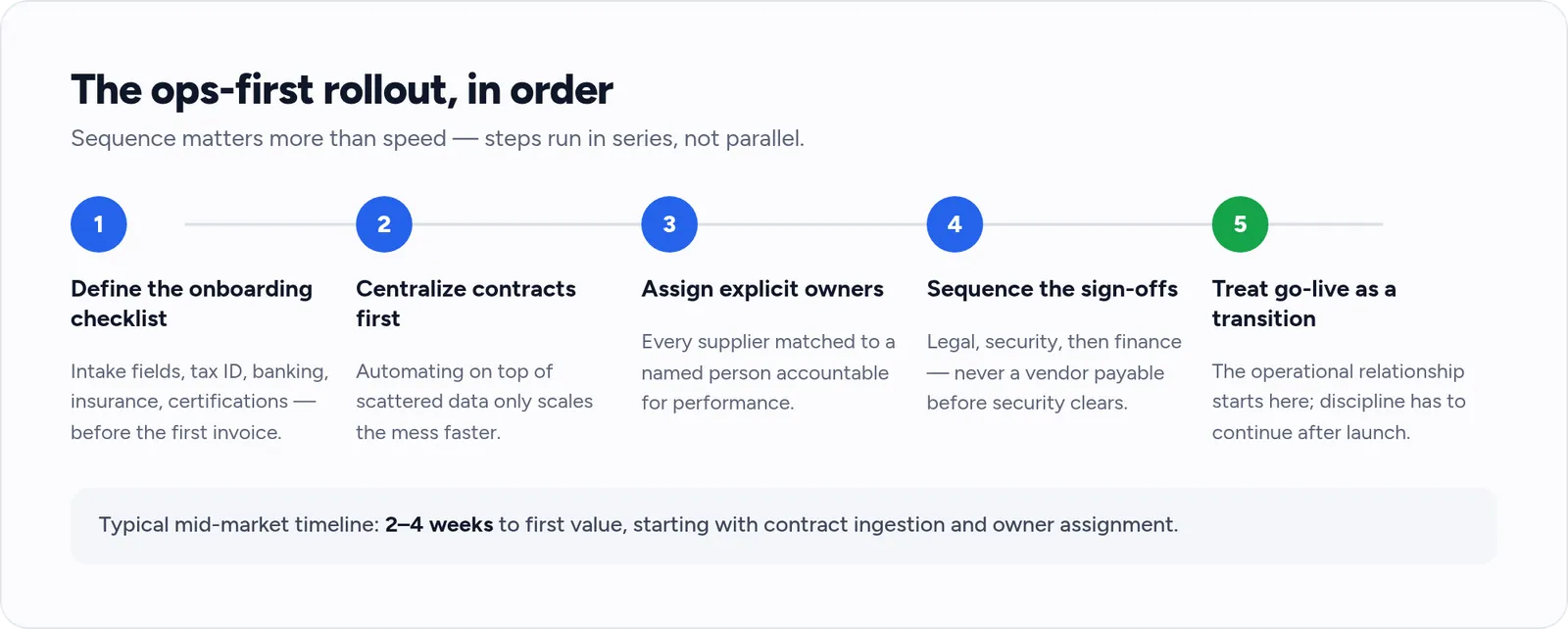
Software deployment must be treated as an operational process rather than a simple IT installation. Follow these foundational steps to ensure successful adoption:
- Define the Onboarding Checklist: Document all the information and security requirements (e.g., security declarations, tax forms) a vendor must complete before they are allowed to submit their first invoice.This includes core intake fields - legal name, tax ID, banking information, insurance coverage, and relevant certifications - alongside compliance items. A standardized checklist means reviews don’t start from scratch with every new vendor.
- Centralize Current Contracts First: Do not attempt to automate workflows with messy data. Gather all active agreements into one digital repository before setting up automated workflows. Automating on top of scattered data only scales the mess faster.
- Assign Explicit Internal Owners: Match every active supplier with a named individual inside your organization who is responsible for verifying performance and approving renewals. This removes the ambiguity over who follows up on activities when something goes wrong.
- Sequence Legal, Security, and Finance Sign-Offs Correctly: Onboarding steps that happen out of order creates clear risks. For example, activating a vendor for payment before a security review is complete. Build your workflow so each function signs off in the right sequence, not in parallel or on an ad hoc basis.
- Treat Go-Live as a Transition, Not a Finish Line: Getting the software live and vendors onboarded is not the end of the process - it’s the point where the operational relationship actually begins. Ongoing data accuracy, renewal tracking and performance reviews all depend on the discipline established in the first four steps continuing after deployment, not stopping once the system is switched on.
Frequently Asked Questions
What is a vendor management system?
A vendor management system (VMS) is a software platform that helps businesses manage and optimize their relationships with third-party suppliers by centralizing contracts, tracking performance, and automating processes such as onboarding and payments. VMS solutions streamline procurement and compliance, supporting risk management and cost control across an organization’s vendor base.
What is the best software for vendor management?
The best software for vendor management depends on an organization's size, industry, and specific needs. Leading solutions often offer contract management, performance tracking, and compliance features. Software like Zelosify, the AI VendorOps platform that turns vendor contracts, SOWs, timesheets, and invoices into one operating workflow, is among several options cited for robust functionality.
What is vendor management process?
A vendor management process is a structured approach to acquiring, managing, and evaluating a company's external vendors to optimize business outcomes and mitigate risk. Key activities include vendor selection, contract negotiation, performance assessment, and ongoing relationship management within overall vendor operations. Best practices and process steps can vary depending on organizational needs
What are the four stages of vendor management?
The four stages of vendor management are usually: vendor selection, contract negotiation, performance monitoring, and relationship management. These stages provide a structured approach to effective vendor operations, enabling organizations to maximize value, reduce risk, and ensure service quality throughout the vendor lifecycle.
What are vendor management tools?
Vendor management tools are software platforms that help businesses track, evaluate, and collaborate with external suppliers or service providers [VERIFY + SOURCE]. These tools typically include features for onboarding vendors, monitoring compliance, tracking invoices, managing contracts, and ensuring performance against service level agreements.